Stop Losing Referral Commissions: Referral Commission Tracking for Finance
Zac Sheffer · August 28, 2026 · 8 min read
Referrals show up however they want to. A text, an email, a quick mention at the end of a call. Then they sit in inboxes and spreadsheets nobody trusts, until someone asks who sent which client and nobody can answer with confidence. I've watched where that moment leads. Without referral commission tracking, the commission doesn't get paid, the partner quietly starts wondering whether sending you business is worth it, and your most profitable growth channel stalls without anyone deciding it should.
This is a finance problem wearing a marketing costume. You don't fix it with more referrals. You fix it by accounting for the ones you already get.
TL;DR: Referral commissions leak at five points (capture, attribution, calculation, timing, and statements), and spreadsheets fail at all five. The fix is a system of record that tracks every intro from first mention to paid commission.
The most profitable revenue you're not accounting for
Referred customers aren't just easier to close. A study published in the Journal of Marketing compared nearly 10,000 banking customers, half referred and half acquired through traditional marketing, and found the referred customers were worth 16 to 25% more in long-term value and were about 18% more likely to stay.
Most firms never see that math, because most firms never formalize the channel. In a survey of 600+ B2B professionals by Influitive and Heinz Marketing, only one in three organizations had a formal referral program. The ones that did generated twice as many high-quality referrals, and 45% of them saw referral-to-close conversion improve, versus 21% of everyone else.
The implication is uncomfortable. If referrals are your highest-value channel, the money flowing through them deserves the same rigor as payroll. Almost nobody gives it that. We didn't either, before we built a company around fixing it. If you want a number for your own firm, the referral ROI calculator estimates what untracked intros are costing you annually.
Where do referral commissions actually leak?
Commission leakage is the gap between what your partners should have been paid for the referrals they sent and what they actually were. "We lost a commission" is never one event. It's a failure at one of five specific points, and each one has a different fix.
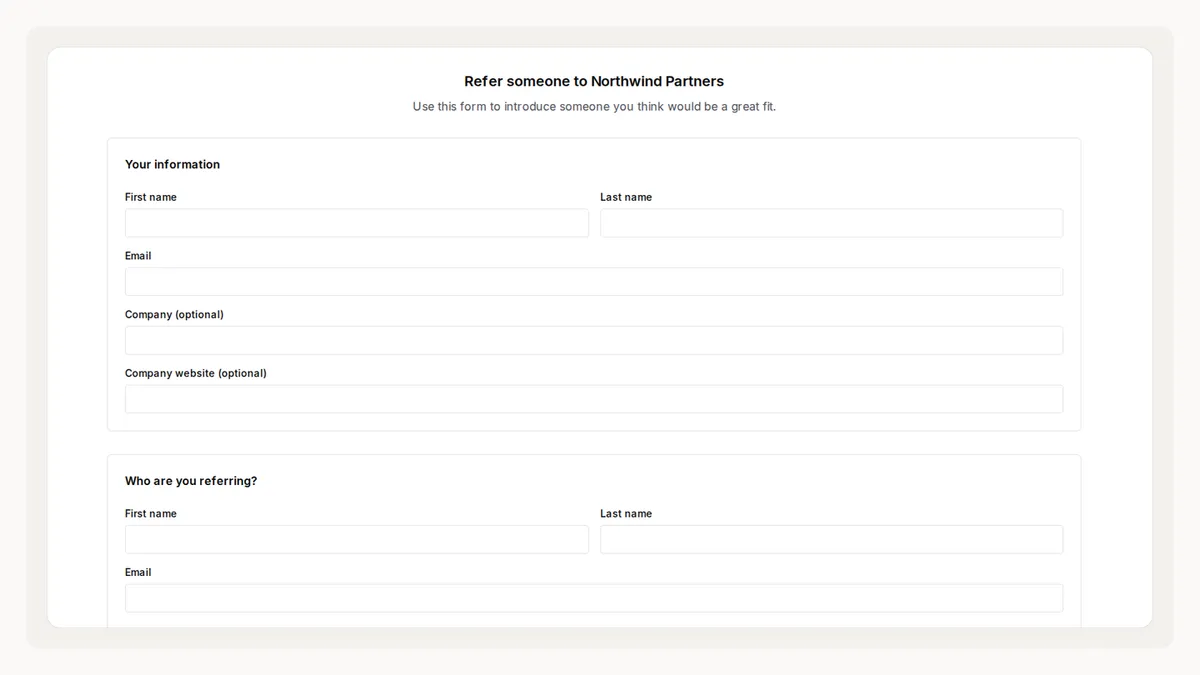
- Capture. The intro lives in someone's inbox or phone and never enters a system. Six weeks later it's not a referral anymore, just a customer who showed up.
- Attribution. The deal closes months after the intro. The person who received the text has left, or simply forgot. Nobody connects the closed deal back to its source.
- Calculation. The deal is attributed, but the spreadsheet applies last year's rate, misses a tier change, or has a broken formula nobody has audited.
- Timing. The commission is calculated but paid on the wrong trigger, like a signed contract that never pays its invoice, or just later than you promised. Quarterly is a fine cadence; quarterly-ish is not. Even enterprises with dedicated comp teams struggle here. 47% take four-plus weeks just to process a payout.
- Statement. The partner gets a number with no math behind it. Every question becomes a dispute settled by memory, and memory always favors the person who isn't getting paid.
Most firms leak at two or three of these points at once. The leakage assessment is a five-question version of this diagnosis for your own process.
Why do spreadsheets fail at commission tracking?
The research on spreadsheet reliability is brutal. Field audits reviewed by Raymond Panko at the University of Hawaii found errors in 86 to 91% of operational spreadsheets, and the documented disasters include a $92 million loss caused by a single wrong date cell.
Commission tracking is the worst possible workload for a spreadsheet. The numbers change over long horizons. A referral made in January closes in June and pays out monthly for two years. Rates and tiers change mid-stream. Multiple people edit the file with no audit trail. And the output is money someone else is owed, which means every error is either margin you gave away or a partner you shorted.
The outcomes are measurable. In Xactly's survey of 240+ organizations, more than 80% of companies were not fully accurate in their commission payouts. Eight years later the picture had barely improved. CaptivateIQ's 2025 study found 66% of companies had over- or under-paid commissions in the past year, and 47% were still running the process on spreadsheets.
Note who was surveyed. These are enterprises with dedicated compensation teams and budget for tooling. If they mispay two-thirds of the time on their own employees, a rate table living in a tab of the billing spreadsheet isn't beating those odds on your partners.
The cost isn't just the mispaid dollars. Salesforce's sales compensation research found three in four reps wish for more transparency in how their pay is calculated, nearly half feel their pay isn't fair, and some keep their own shadow spreadsheets just to check every commission. And those are employees who can walk down the hall and ask. An external partner has less visibility and more options. A partner who doubts your math doesn't file a complaint. They send the next intro to someone else, and you never find out why.
What does referral commission tracking change?
Fair warning, this is the part we built Introzy to do, so read it as a design spec you can hold us to. The fix maps one-to-one onto the five leak points.
- Capture where the referral happens. Forwarded email, shared link, Slack message, or partner portal, the intro enters the system the moment it exists, with the introducer attached. That's the whole job of referral tracking. No referral should depend on someone remembering to log it.
- Attribution that survives the sales cycle. The introducer stays attached to the deal from intro through invoice, so a deal that closes in month six still credits the person who started it in month one.
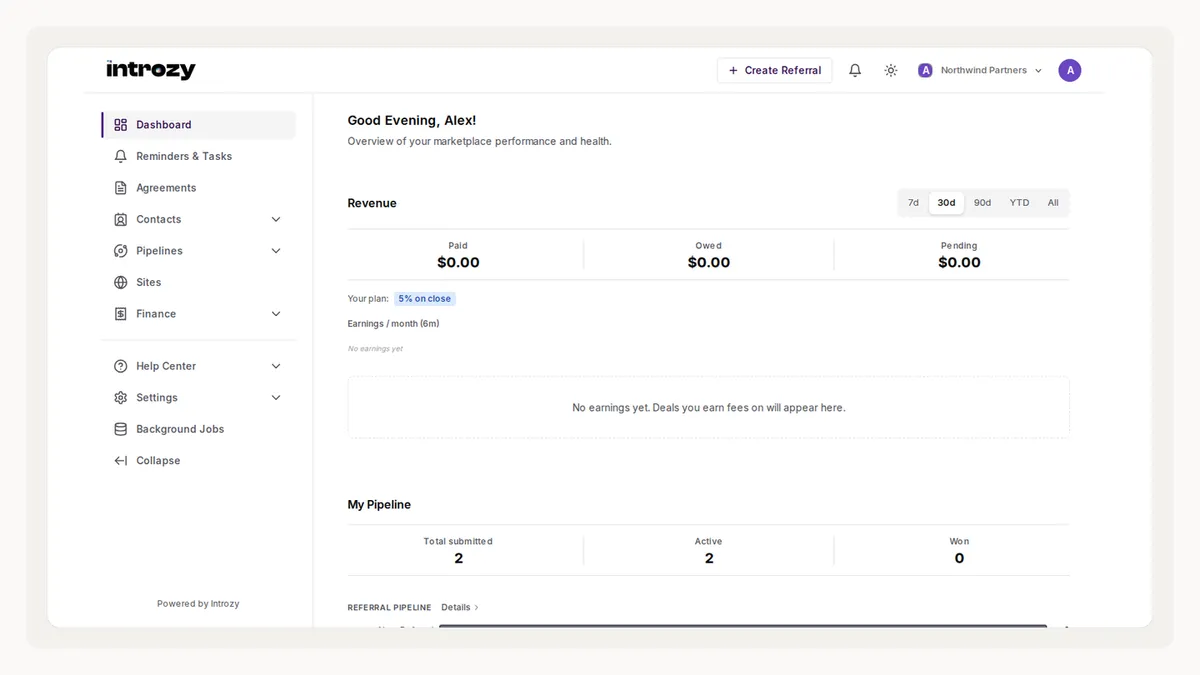
- Commission math defined once. Flat fee, percentage, or tiers get set up as a fee plan, and every deal event calculates against it. No formulas to break, no rate table to forget updating.
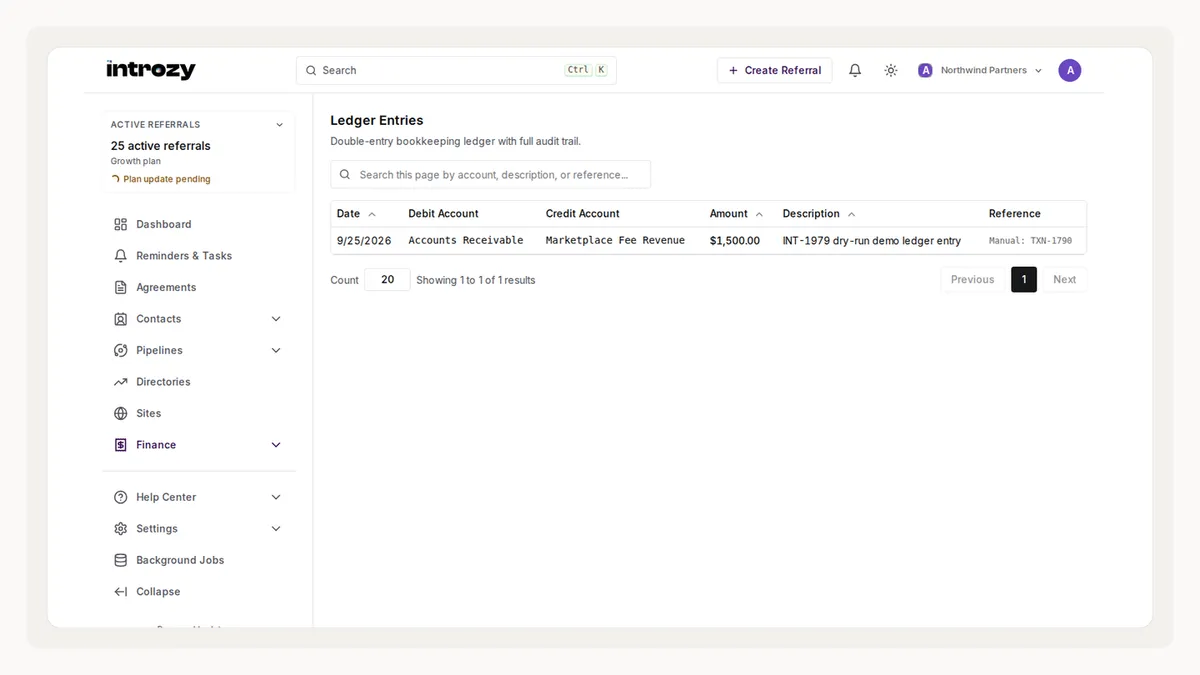
- Payment triggered by collected cash. Commissions calculated on money that actually arrived, with Stripe handling collection, mean you never pay out on an invoice that later goes unpaid.
- Statements both sides can see. Partners watch their earnings move from earned to invoiced to paid in their own portal, with downloadable statements showing the math. Nothing gets disputed by memory, because nothing depends on memory.
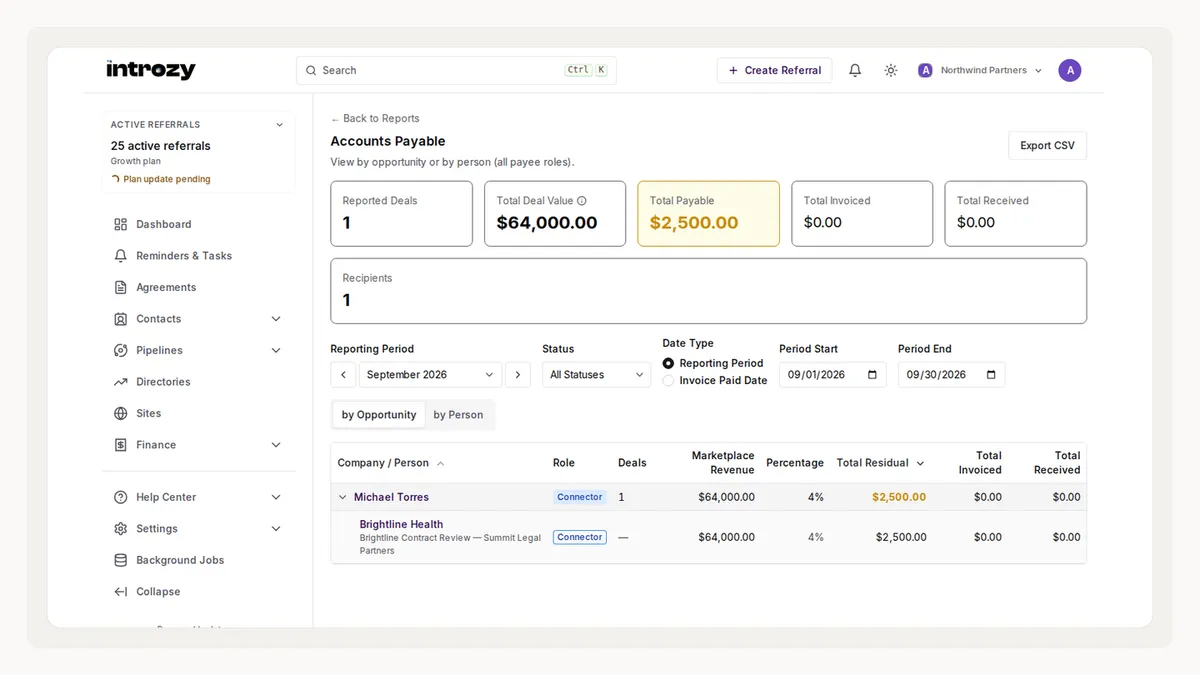
The side effect is that finance questions become reporting questions. Which partners drive the most collected revenue, which referral sources convert, what the channel actually returns. If you're building toward that, the six numbers in the metrics that matter in a partner program are the place to start.
What is a fair referral fee?
Getting the operations right raises the obvious next question, which is what the fee should be. The honest answer is that it varies by industry, involvement, and deal economics, but there are established ranges.
- Agencies. For a simple introduction, 5 to 10% of collected revenue is typical, with 10% most common. Formal partner programs run richer. A review of 556 agency partner programs found a median referral commission of 20% among the programs that publish their rates. More on how agencies structure this on our agencies page.
- Law firms. Fee division between lawyers is governed by ABA Model Rule 1.5(e). The split must reflect proportional work or joint responsibility, the client must consent in writing, and the total fee must be reasonable. Sharing fees with non-lawyers is restricted separately. For firms, documentation isn't an operational nicety, it's an ethics requirement, which is why tracking referred matters end to end matters more here than anywhere.
- MSPs. A common structure is 5 to 10% of monthly recurring revenue for the first 12 to 24 months, which is precisely the long-horizon, recurring math that breaks spreadsheets. See how MSPs prove and pay intros through closed contracts.
If you want a defensible number instead of a guess, the referral fee calculator publishes its math, and the partner earnings calculator shows the partner's side of the same equation.
Frequently asked questions
How does Introzy capture referrals from texts and emails?
Email intros get forwarded straight in and Slack messages are captured where they happen. Everything else (a text, a call, a hallway mention) takes a ten-second shared link or portal entry at the moment it happens, not a memory test at the end of the quarter. The point is meeting the referral where it happens instead of asking anyone to change how they make intros.
What happens if a referral doesn't convert?
It stays tracked. The attribution and stage history remain attached, so you can see which partners send referrals that close, which send volume that doesn't, and coach accordingly. Unconverted referrals are data, not waste.
When do partners actually get paid?
Commissions calculate against your fee plan as deals progress and payments collect, and partners see earnings move from earned to invoiced to paid on their statements. Paying on collected revenue, not signed contracts, protects both sides.
We only get a few referrals a month. Do we really need a system?
The leak isn't about volume, it's about time. Two referrals a month is 24 a year, each closing months after the intro and often paying out over a year or more. That's dozens of open promises spread across overlapping horizons, which is exactly the shape of problem that memory and spreadsheets get wrong. It's also why the free tier exists. A five-partner program shouldn't need a budget line to run correctly.
How does this improve partner relationships?
Every payout traces back to a specific referral, deal, and rule that both sides can see. Partners stop wondering whether they were credited, you stop reconstructing history from old emails, and the relationship runs on statements instead of trust falls.
Referrals are already the best revenue most professional services firms have. The firms that win with them aren't the ones with the most contacts. They're the ones where every intro gets captured, credited, and paid without a scramble. Get started free →
Stop reading about referrals. Start tracking them.
Free up to 5 referrals a month. Every feature included. No card to start.